

Young people who experience positive family communication experience higher self-esteem, decreased substance use, less anxiety and depression, and greater school engagement.
Students are less likely to be delinquent or drop out, and more likely to achieve higher grades and standardized test scores. Studies show that students from poor families whose parents are highly involved with their education do about as well as students from wealthier families.
Joyce Epstein of the National Network of Partnership Schools developed a framework for understanding six different kinds of parent involvement:
1) Parenting: families establish home environments that support children’s learning
2) Communicating: families and schools engage in effective two-way communications about student expectations and progress
3) Volunteering: parents directly support the classroom or school
4) Learning at home: families help students with homework and school-related decision-making and planning
5) Decision making: parents are involved in school decisions
6) Community collaboration: community services are resources integrated to strengthen schools and families
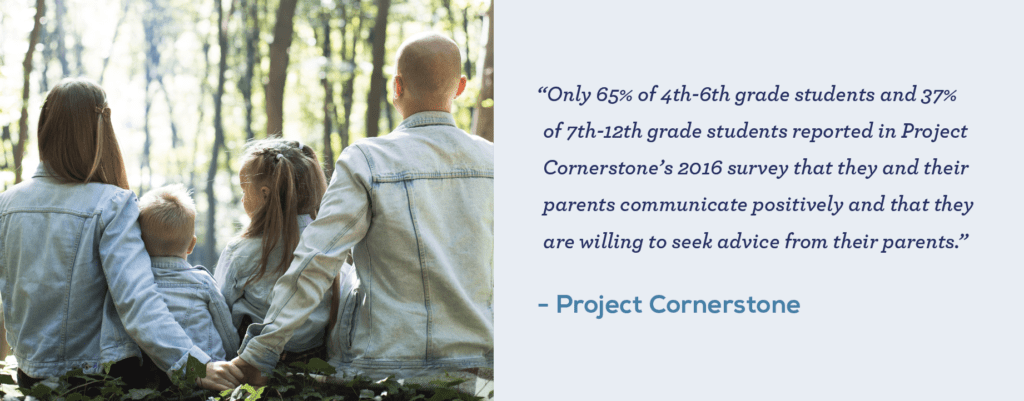
“Only 65% of 4th-6th grade students and 37% of 7th-12th grade students reported in Project Cornerstone’s 2016 survey that they and their parents communicate positively and that they are willing to seek advice from their parents.”
– Project Cornerstone
Parents whose schedules don’t allow volunteering can still support their children’s academic success through parenting, communication, and learning
at home.
For positive family communication to occur, all family members must be comfortable sharing their needs, wishes, and concerns in an honest and trusting environment without fear of rejection. Establishing positive communication when children are young may help keep the channel open in adolescence.
No matter how old your children are, it’s never too late to start! The following questions can help your family. Encourage your child to answer these questions honestly:
• Who do you enjoy talking with, and why?
• What makes it easier to talk to family members, and what makes it more difficult?
• Which topics are easiest for you to talk about with your parents, and which are more difficult? Why?
The communication skills that young people develop in their families help set the pattern of how they’ll communicate for the rest of their lives. Teaching your children to communicate effectively with friends, teachers, co-workers, parents, peers, and others is a lasting legacy that parents can give to their children.
FOR FAMILIES
• Create opportunities for unstructured communications. Sometimes the best conversations occur when you’re side-by-side instead of face-to-face, such as when you’re driving or working together in the kitchen.
• At dinnertime, instead of asking “How was your day?” play Worst and Best, where everyone—including parents—takes turns sharing the worst thing and the best things that happened to them during the day.
• Hold regular family meetings to check in with each other and discuss family issues like holidays or chores. Make sure everyone has an opportunity to participate.
• Try having each parent set an “individual date” with each child where they spend time together away from home somewhere where they can talk, like a restaurant or coffee shop. This kind of one-to-one conversation makes it possible for a young person to discuss issues privately with their parent’s undivided attention.
• Listen more than you talk.
• Positive family communication isn’t just between parents and children—siblings should also be encouraged and supported to communicate with each other openly and effectively.
FOR ALL ADULTS
• Model positive, respectful communications at all times.
• Talk to young people about the importance of family communication
At school or in youth programs
• Send home a list of “conversation starters” with information about the value of positive family communication. (See Resources at the end of this document for suggested books.)
• Assign homework that requires students to talk to parents or other family adults.
• Create and deliver a unit on “family” that helps youth understand different kinds of families and appreciate their own.at all school events. Try to make sure that written communications are provided in the parents’ language.
• Make sure that faculty are fully aware of the importance of parent involvement for all students. Encourage them to create meaningful chances for parents with diverse backgrounds to participate through programs that value their unique knowledge, background, and skills.
RESOURCES
The following books offer practical tips on creating and improving family communication:
How to Talk So Kids Will Listen and Listen So Kids Will Talk
The Essential Guide to Talking with Teens
Conversations on the Go: Clever Questions to Keep Teens and Grown-Ups Talking
Parent Further covers several topics related to positive family communication, including tips on how to talk about emotions, developing listening skills, and the impact (positive and negative) of digital technologies on communication.
About the Asset of the Month Program
The goals of the Asset-a-Month program are to help align adults throughout our diverse community in their efforts to promote positive youth development by fostering developmental assets.